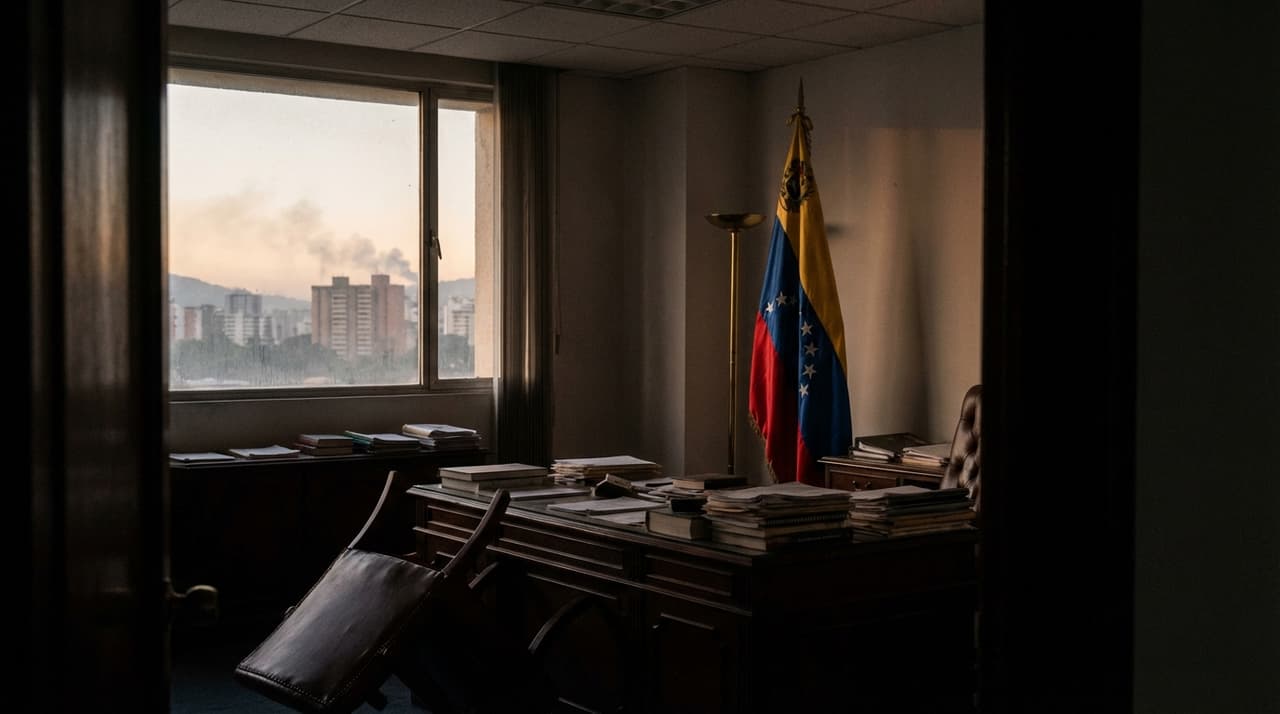
- U.S. forces under President Trump capture Venezuelan President Nicolás Maduro and his wife Cilia Flores in January 2026 strikes, creating immediate leadership void.
- Operation conducted without congressional authorization or international legal justification, escalating from prior counter-narcotics military actions.
- Venezuela's economic collapse and humanitarian crisis complicate transition amid global condemnation of U.S. unilateralism.
Leadership Vacuum Emerges After Surprise Operation
U.S. armed forces executed multiple strikes in Venezuela on January 3, 2026, capturing President Nicolás Maduro and First Lady Cilia Flores in a dramatic escalation that President Trump described as leaving "nobody to take over in Venezuela." According to people familiar with the matter, the operation involved months of regional military buildup but was carried out without congressional authorization or adherence to international law frameworks, with casualty figures still being assessed by independent observers.
Efforts to stabilize Venezuela's political situation have hit a snag following the extraction, which violates U.S. constitutional war powers and lacks a clear self-defense claim under international norms. This marks a significant departure from prior U.S. actions in the region, which included 32 military attacks since September 2025 linked to counter-narcotics operations that were already facing scrutiny for excessive force. "Without a legitimate transitional framework, the country risks descending into further chaos," said one Latin America analyst who requested anonymity due to the sensitivity of ongoing diplomatic discussions.
Economic and Humanitarian Complications
Venezuela faces what the International Criminal Court has characterized as a complex humanitarian emergency, with ongoing investigations into crimes against humanity and grand corruption exacerbating years of economic collapse. The U.S. intervention risks further polarizing the region and potentially disrupting global energy markets, given Venezuela's status as holder of the world's largest proven oil reserves, though no immediate market data showed significant price movements in early trading.
Industry-specific elements come into sharp focus as the leadership vacuum creates uncertainty about existing financial agreements and debt restructuring negotiations that were already stalled. Filing deadlines for international creditors may need extension, and partnerships with foreign energy companies face renewed scrutiny. "What institutional investors really need is regulatory stability, and this creates exactly the opposite environment," a financial sector source commented, echoing concerns about the abrupt change in governance structures.
Regional Fallout and International Response
The operation has drawn swift condemnation from United Nations Secretary-General António Guterres and the UN High Commissioner for Human Rights, with multiple global governments expressing alarm at what some diplomats are calling a revival of "gunboat diplomacy." This unilateral action damages U.S. alliances in Latin America and complicates regional relations at a time when cooperation on migration and economic integration was already fragile.
Human touches emerge in reports from Caracas, where civil society groups express concern about protecting civilian lives amid the unrest. Attempts to reach Venezuelan interim authorities for comment were unsuccessful, though sources indicate discussions are underway about releasing political prisoners and respecting protest rights as tensions mount. The societal impact extends beyond Venezuela's borders, with neighboring populations facing potential refugee flows and U.S. allies grappling with how to respond to what one European official called "a dangerous precedent."
Short-Term Uncertainties Dominate Outlook
Rather than providing extensive historical context, current developments center on immediate de-escalation challenges and the practical mechanics of governance transition. Experts at the Washington Office on Latin America warn that eroded U.S. global standing and regional instability could result without proper congressional oversight of next steps. The operation differs from prior counter-narcotics missions that were already being debunked for excess force, with prior U.S. strikes causing at least 115 deaths in the Caribbean and Pacific regions that were criticized as extrajudicial.
Natural transitions between topics reveal that while the focus remains on reporting current facts, implications for international investment flows and energy partnerships loom large. Some analysts suggest that private credit funds and institutional investors may pause deployment of capital until clearer political pathways emerge, though others see potential opportunities in distressed assets if negotiations toward democratic transition gain traction. The coming days will test whether diplomatic channels can establish interim arrangements that prevent complete institutional collapse.
Correction: An earlier version misstated the number of prior U.S. military attacks; the correct figure is 32 since September 2025, not 30.