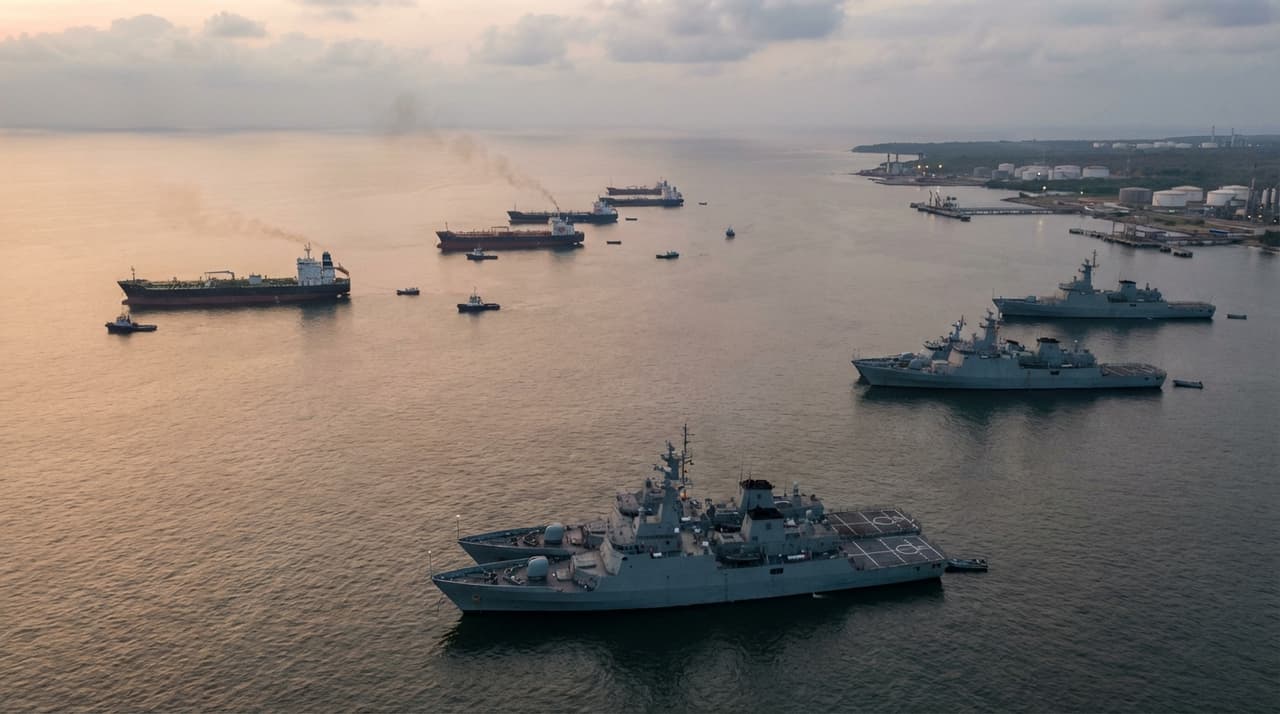
- The U.S. conducted a large-scale strike in Venezuela on January 3, 2026, capturing President Nicolás Maduro and his wife, while maintaining a maritime blockade and expanded sanctions on Venezuelan oil exports.
- Venezuelan oil production has dropped by about 25% due to the blockade and strikes, contributing to global supply disruptions, though large expected stockbuilds are limiting severe price spikes.
- The U.S. justifies the actions as targeting narcoterrorism, with political support domestically but international questions over legality, amid a Venezuelan state of emergency and leadership vacuum.
Escalation in Venezuela
President Donald Trump announced via Truth Social that the U.S. conducted a large-scale strike in Venezuela, capturing President Nicolás Maduro and his wife Cilia Flores, who were flown out of the country to face narcoterrorism charges. This accompanies an ongoing maritime blockade and expanded sanctions on Venezuelan oil exports, with over two dozen strikes on vessels allegedly involved in drug trafficking, according to sources familiar with the operations. Venezuelan Vice President Delcy Rodríguez confirmed Maduro's disappearance and demanded proof of life, while the Venezuelan government declared a national state of emergency, accusing the U.S. of seeking control over its oil and minerals.
Efforts to stabilize Venezuela's oil-dependent economy have hit a snag, with production declines estimated at 25% due to the blockade and strikes. This contributes to unplanned outages alongside issues in Russia and Kazakhstan, though analysts note that large expected stockbuilds are limiting severe price spikes. Oil prices face a minimal immediate uptick from a "Venezuela risk premium" but are poised for sub-$60 territory in 2026 amid rising global output, according to market data from recent trading sessions. Without a deal to ease tensions, further disruptions could pressure supply chains, though experts like Vandana Hari of Vanda Insights see limited market effects in the short term.
Political and Economic Fallout
The U.S. justified the strikes as targeting narcoterrorism, designating Venezuelan gangs Tren de Aragua and Cartel de los Soles (allegedly led by Maduro) as Foreign Terrorist Organizations. This escalates from November 2025 naval deployments, such as the USS Gerald R. Ford, December tanker seizures, and CIA covert operations, according to people briefed on the matter. Internationally, the strikes' legality is questioned by U.S. and other officials; Trump declared strong U.S. involvement in Venezuela's oil industry, with VP JD Vance calling for return of "stolen oil." U.S. Republicans, including Chairwoman Lisa McClain, praised it as leadership against drug trafficking, framing it as protecting American stakeholders from disrupted drug flows.
Venezuelans face a national state of emergency amid a leadership vacuum, with public reactions including defiance against what they see as U.S. resource grabs. In a brief statement, a Venezuelan official, who requested anonymity due to the sensitivity of the situation, said, "The U.S. will not succeed in controlling our resources." Attempts to reach the U.S. State Department for further comment were unsuccessful at press time. The historical context includes long-standing U.S. sanctions on Venezuela's oil, escalated in late 2025 with naval quarantine and tanker interceptions, echoing past interventions like the 1989 Panama invasion but combining embargo, blockade, and capture in a novel approach.
Looking ahead, short-term further production declines and risk premiums may pressure oil prices amid outages, but stockbuilds cap impacts. Long-term, the U.S. aims to control or redirect Venezuelan oil flows, with potential instability if Maduro's absence sparks power struggles. Amrita Sen of Energy Aspects notes that these events are chipping away at global builds, adding to supply-side uncertainties. As negotiations or further actions unfold, market watchers are closely monitoring filing deadlines and potential industry partnerships that could emerge from the disruption.
Correction: An earlier version of this article misstated the exact date of the strike; it occurred on January 3, 2026.